
The Science of Sleep Posture: How to Optimize Your Sleeping Position for Pain-Free Mornings
Waking up refreshed, energized, and ready to take on the day is a universal goal, yet millions of people start their mornings in physical frustration. If you routinely wake up with a stiff neck, a dull ache across your lower back, or a stubborn tightness in your shoulders, you might blame your stress levels, your demanding job, or your age. However, the true culprit is often far more subtle: your sleep posture.
While we tend to think of sleep as a completely passive state of rest, your body is physically engaged with your sleeping environment for seven to eight hours every single night. If your spine is forced out of its natural alignment during this extended window, your muscles, ligaments, and joints undergo sustained structural stress. Over time, poor sleeping mechanics can lead to chronic musculoskeletal issues, tension headaches, and systemic fatigue.
To break this cycle of discomfort, it is essential to understand the biomechanics of sleep. By learning how to optimize the three major sleeping positions—side, back, and stomach—through strategic pillow placement, you can structurally protect your spine and unlock truly restorative, pain-free rest.
The Crucial Goal: Maintaining a Neutral Spine
Before diving into specific sleeping positions, it is vital to understand what your body is trying to achieve mechanically while you sleep. The ultimate objective of healthy sleep posture is to maintain a neutral spine.
Your spine is not a perfectly straight line; it possesses three natural, healthy curves: an inward curve at the neck (cervical spine), an outward curve at the upper back (thoracic spine), and an inward curve at the lower back (lumbar spine). A neutral spine means that all three curves are supported and aligned, resting in a balanced position that exerts the absolute minimum amount of stress on the surrounding tissues.
When your mattress is too soft, your pillows are too thick, or your limbs are unsupported, your spine sags or twists. This forces your muscles to contract involuntarily to protect the spinal cord, leading to that familiar, painful morning stiffness.
1. Side Sleepers: Mastering Lateral Alignment
Side sleeping is statistically the most popular sleeping position in the world. It offers excellent benefits, including improved digestion, reduced acid reflux, and a lower likelihood of snoring or sleep apnea. However, side sleeping introduces a major biomechanical vulnerability: pelvic rotation.
When you lie on your side, your top leg naturally drops forward to rest on the mattress. This subtle movement pulls your pelvis forward, twisting your lower spine out of alignment. Additionally, if your head pillow is too thin, your neck sags toward the mattress; if it is too thick, your neck is propped unnaturally upward. Both scenarios pinch the cervical nerves.
The Structural Optimization:
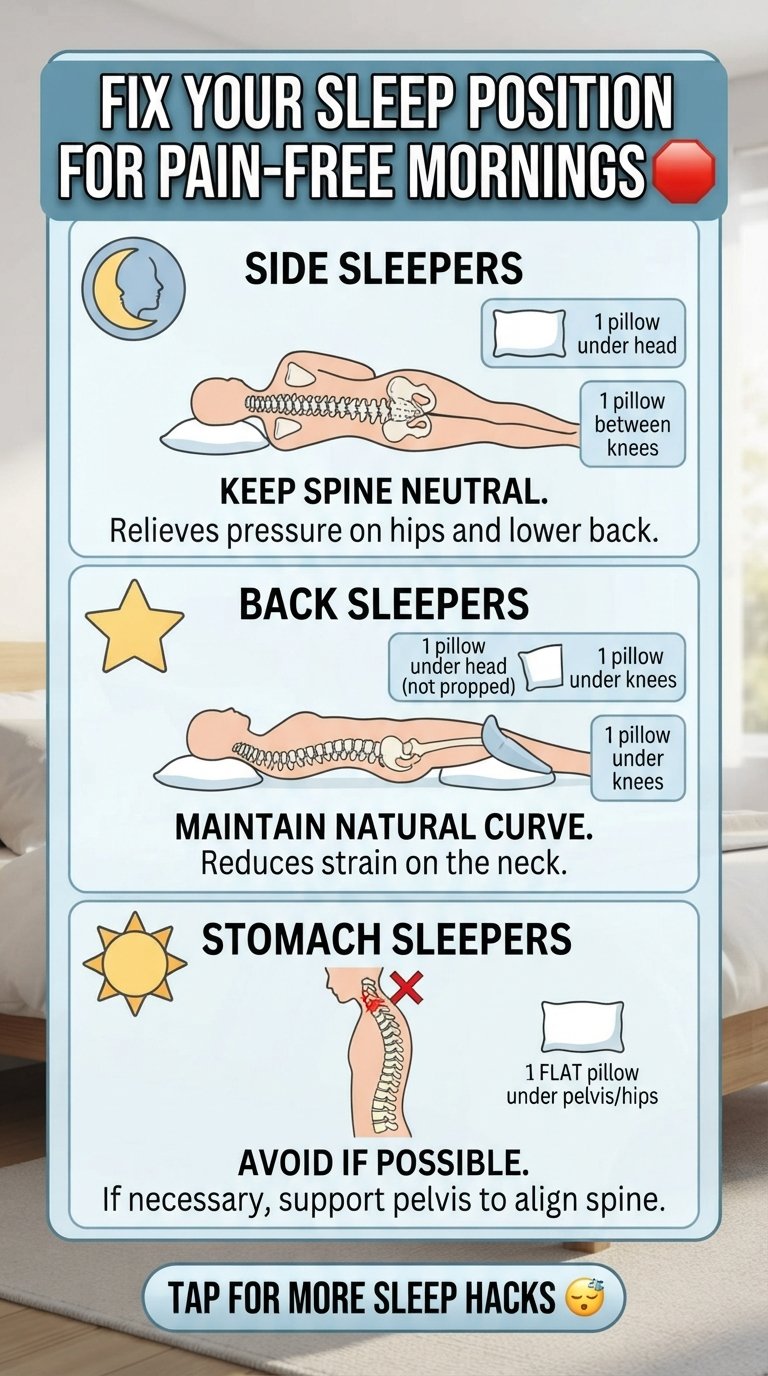
- The Head Pillow: Select a firm, contoured pillow that completely fills the gap between your ear and the tip of your shoulder. This keeps your neck perfectly horizontal and aligned with your upper back.
- The Knee Pillow: Place a supportive, medium-thickness pillow between your knees and ankles.
- The Biomechanical Benefit: The pillow between your knees stacks your hips directly on top of one another. This single adjustment prevents the upper leg from sliding forward, completely neutralizing pelvic rotation and relieving structural pressure on your hips and lumbar spine.
2. Back Sleepers: Protecting the Lumbar Curve
Orthopedically speaking, back sleeping is often considered the ideal position for weight distribution. Sleeping flat on your back evenly distributes your body weight across your frame, minimizing pressure points and allowing your internal organs to rest naturally.
Despite these structural benefits, back sleeping can easily backfire without proper support. When your legs are completely extended flat against a mattress, the tight hip flexor muscles pull on the lower pelvis. This mechanical pull flattens the natural arch of your lower back, pressing it forcefully against the bed or arching it into a tense, unsupported bridge. Furthermore, a high head pillow can thrust your chin toward your chest, straining the cervical muscles.
The Structural Optimization:
- The Head Pillow: Opt for a thin or medium-depth pillow that cradles the back of your head while gently supporting the curve of your neck. Your gaze should be directed straight up at the ceiling, not toward your feet.
- The Knee Pillow: Place one or two pillows directly underneath your knees.
- The Biomechanical Benefit: Elevating your knees slightly flexes your hips. This action relaxes the hip flexors and instantly restores the natural, gentle curve of your lumbar spine, taking the structural weight off your lower back muscles.
3. Stomach Sleepers: Minimizing the Strain
Stomach sleeping is widely regarded by physical therapists and chiropractors as the most challenging position for the human body. While it can successfully eliminate snoring, it forces the torso into an unnatural position that is incredibly difficult to neutralize.
When you sleep on your stomach, gravity pulls your heavy midsection and pelvis deep into the mattress. This creates an exaggerated, unsupportive dip in your lower back. Compounding this issue, you cannot breathe through a pillow, which forces you to turn your head completely to one side for hours at a time. This twists your upper neck, straining the muscles and compression points along your cervical vertebrae.
The Structural Optimization:
- The Pelvic Pillow: Place a flat pillow directly under your pelvis and lower hips.
- The Head Pillow: Transition to an ultra-thin pillow, or choose to sleep with no pillow under your head at all.
- The Biomechanical Benefit: Elevating your hips with a flat pelvic pillow lifts your midsection out of the mattress, preventing your lower back from sagging into a painful arch. Removing or thinning the head pillow keeps your twisted neck closer to a neutral plane, lowering the risk of waking up with a severe kink in your neck.
Transforming Your Routine
Optimizing your sleep posture is a structural health investment that yields immediate dividends for your daily energy and mobility. While altering a lifelong sleeping habit takes time, utilizing targeted pillows to enforce a neutral spine will significantly reduce morning aches and pains. Listen to your body’s morning feedback, adjust your pillow placement accordingly, and enjoy the profound benefits of genuinely restorative sleep.
Now that the full article text is written, I can format this into a downloadable PDF text file layout, generate a matching email newsletter draft to promote it, or create a table summarizing the pillow placements for a quick reference section. Let me know what you need next!
What is the single healthiest sleeping position for your body?
Orthopedically, sleeping on your back is considered the healthiest position because it distributes your body weight evenly and minimizes pressure points. However, it is only ideal if you place a pillow under your knees to preserve the natural curve of your lower back.
Why does sleeping on my side cause lower back pain, and how do I stop it?
Side sleeping causes back pain because your top leg naturally drops forward, twisting your pelvis and pulling your lower spine out of alignment. To stop this instantly, place a firm pillow between your knees to keep your hips perfectly stacked and your spine neutral.
Is it bad to sleep on your stomach?
Yes, stomach sleeping is generally considered the hardest position on your musculoskeletal system. It forces your lower back to sag into an exaggerated arch and strains your neck because you must turn your head to one side for hours. If you cannot switch positions, place a flat pillow under your pelvis to alleviate the strain.
read more:









2 thoughts on “The Science of Sleep Posture: How to Optimize Your Sleeping Position for Pain-Free Mornings”