When people hear the words bone cancer, they may imagine a tumor growing inside a bone. But bone cancer can do much more than simply create a mass. In some cases, it can dramatically change the structure and appearance of the bone itself.
One of the most striking examples can be seen on medical imaging, where an aggressive bone tumor may cause thin, irregular projections of newly formed bone to radiate outward from the surface. This distinctive pattern is often described as a “sunburst” or “sunray” appearance because the bony spicules can resemble rays of sunlight extending from the bone.
One cancer particularly associated with this appearance is osteosarcoma, a malignant tumor in which cancer cells produce abnormal bone. Osteosarcoma is the most common primary malignant bone tumor and frequently occurs in children, teenagers, and young adults.
But what exactly does bone cancer look like, and why can it create such an unusual pattern?
What Does Bone Cancer Look Like?
There is no single appearance that represents every case of bone cancer.
Bone tumors can look very different depending on the type of cancer, the location of the tumor, how quickly it is growing, and how the surrounding bone responds. Some tumors cause areas of bone destruction, while others stimulate the body to produce abnormal new bone.
On an X-ray, an aggressive bone tumor may appear as an area where the normal structure of the bone has been disrupted. The bone can become thinner, weaker, irregular, or partially destroyed. In other cases, new bone forms around the tumor.
With certain aggressive tumors, this new bone formation can create radiating lines or spicules extending outward from the bone. This is the appearance commonly called the sunburst pattern.
It is an important radiological clue, but it should not be considered proof of cancer by itself.
Why Does Osteosarcoma Create a Sunburst Appearance?
To understand the sunburst pattern, it helps to understand the outer layer of bone.
The surface of most bones is covered by a thin, tough layer called the periosteum. This membrane contains blood vessels, nerves, and cells involved in bone growth and repair.
When an aggressive tumor develops inside a bone and grows toward the outside, it can disturb and lift the periosteum.
The body may respond by producing new bone in an attempt to repair or reinforce the affected area. However, because the tumor is growing rapidly and disrupting normal tissue, the new bone may be laid down in an abnormal and disorganized way.
Instead of forming a smooth layer, strands of new bone can extend outward from the surface. On an X-ray, these strands may appear to radiate away from the bone like rays from the sun.
This is where the term “sunburst” comes from.
The radiating spicules are therefore not the cancer itself. They are a visible consequence of the interaction between the tumor, the bone, and the body’s response to the tumor.
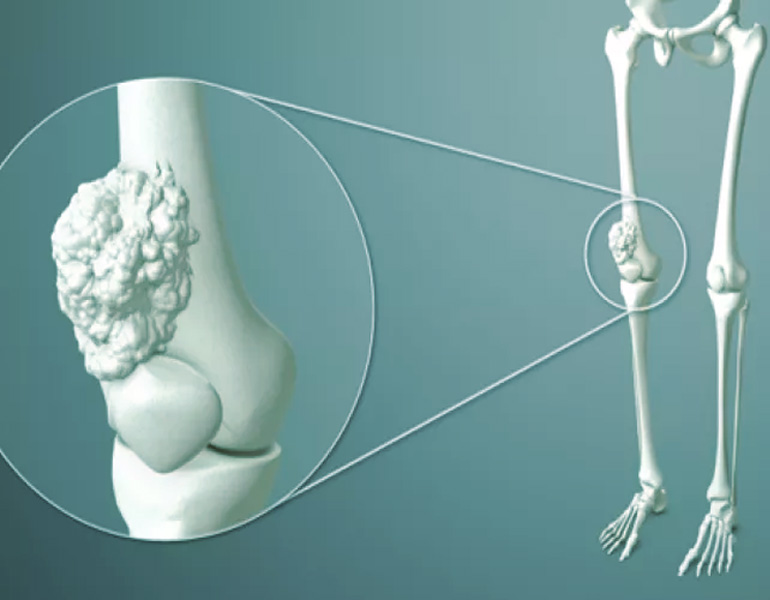
Where Does Osteosarcoma Usually Occur?
Osteosarcoma can develop in different bones, but it has a particular tendency to occur near the ends of long bones.
These areas are often close to growth plates, where bones grow rapidly during childhood and adolescence. Common locations include the region around the knee, particularly the lower part of the thigh bone and upper part of the shin bone.
The upper arm can also be affected, particularly near the shoulder.
Because of this pattern, osteosarcoma is frequently diagnosed in teenagers and young adults, although it can occur at other ages as well.
A rapidly growing tumor in a long bone can interfere with normal bone architecture and produce changes that become visible on imaging.
What Might a Person Notice?
The appearance of a tumor on an X-ray is only one part of the picture. A person with bone cancer may experience symptoms before the diagnosis is made.
One of the most common symptoms is persistent bone pain. The pain may initially come and go or be mistaken for an injury, muscle strain, or growing pains. Over time, however, it may become more frequent or severe.
Swelling or a noticeable lump can also occur, particularly when the tumor has grown significantly.
Other possible symptoms include reduced movement of a nearby joint, tenderness, or difficulty using the affected limb. In some cases, a weakened bone may fracture after relatively minor trauma.
Importantly, these symptoms do not automatically mean that someone has bone cancer. Injuries, infections, benign bone tumors, and many other conditions can cause similar symptoms.
How Do Doctors Detect Bone Cancer?
Doctors use several types of tests to investigate a suspected bone tumor.
X-rays
An X-ray is often one of the first imaging tests performed when a bone tumor is suspected. It can reveal changes in the shape and density of the bone and may show areas of bone destruction or abnormal new bone formation.
A sunburst pattern can be an important clue when present.
MRI Scans
Magnetic resonance imaging, or MRI, provides much more detailed information about soft tissues and the extent of a tumor.
MRI can help doctors determine how far a tumor extends through the bone and into surrounding muscles and other tissues. It is particularly valuable when planning treatment.
CT Scans
Computed tomography, or CT, produces detailed cross-sectional images of the body. CT can provide additional information about the bone and may also be used to evaluate other areas of the body when doctors are assessing whether a cancer has spread.
Biopsy
Although imaging can strongly suggest a bone tumor, imaging alone usually cannot determine exactly what type of tumor is present.
A biopsy involves removing a sample of tissue so that it can be examined under a microscope by a pathologist. The biopsy is an essential part of establishing a definitive diagnosis and determining the specific type of tumor.
Is the Sunburst Pattern Always Bone Cancer?
No.
Although the sunburst appearance is strongly associated with aggressive bone tumors such as osteosarcoma, it is not exclusive to osteosarcoma.
Different diseases and processes can sometimes produce similar patterns of abnormal bone formation. This is why doctors do not diagnose bone cancer based on a single visual feature.
The patient’s symptoms, medical history, physical examination, imaging findings, and biopsy results all have to be considered together.
It is also important to remember that not every osteosarcoma produces a classic sunburst appearance. Bone tumors can have different imaging characteristics depending on their location and biological behavior.
Why Early Medical Evaluation Matters
A persistent bone lump, unexplained swelling, or pain that does not improve should be evaluated by a healthcare professional, especially when symptoms continue or worsen.
Many causes of bone pain are not cancer. Sports injuries, infections, arthritis, benign tumors, and other conditions are much more common explanations for many symptoms.
However, persistent or unexplained symptoms deserve appropriate medical attention rather than being ignored.
Early evaluation can help doctors identify the cause and determine whether further imaging or specialist assessment is needed.
The Bottom Line
Bone cancer does not have one single appearance.
Some aggressive bone tumors can cause extensive destruction of normal bone, while others stimulate abnormal bone production. In osteosarcoma, this abnormal bone formation can sometimes create thin projections radiating outward from the bone surface.
When these projections are seen on an X-ray, they can create the dramatic “sunburst” appearance.
The pattern is a consequence of abnormal bone formation and the tumor’s interaction with the periosteum and surrounding tissues. It can provide doctors with an important clue, but it is not enough to diagnose cancer on its own.
Doctors use imaging techniques such as X-rays, CT scans, and MRI, together with clinical examination and biopsy, to determine what a bone lesion actually represents.
So, when you see an image showing a bone with dramatic rays extending outward, remember that the striking pattern is not necessarily the tumor itself. It is a visible sign of how an aggressive process can alter the normal biology and structure of bone.
If you or someone you know has persistent bone pain, swelling, or an unexplained lump, seek medical advice for an appropriate evaluation. Only a qualified healthcare professional can determine the cause of these symptoms.